Body of US climber Mallory Geis found after Broad Peak avalanche
The remains of US climber Mallory Geis have been found by rescuers following an avalanche on one of the world’s highest mountains, a local government body says.
Geis was part of a 10-person expedition that was on Pakistan’s Broad Peak, on the border with China, when the avalanche happened on Thursday.
According to US media, Geis was 39 and from the Texas city of San Antonio.
Two other bodies – of Nadhira Ahmed Abdullah Al Harthy from Oman and Pur Bahadur Gurun from Nepal – have also been identified.
All have been taken to a hospital by helicopter for “legal formalities regarding identification”, according to the Information Department of Gilgit Baltistan, the local region.
The Alpine Club of Pakistan initially said four bodies had been located on Pakistan’s Broad Peak, before clarifying they had in fact found two bodies and a body part.
Several others were spotted by aerial drones, it said, though their condition would not become clear until rescue efforts resume on Saturday and a search group can reach the area, which could take several hours. Bad weather has been hampering them.
The Alpine Club of Pakistan added that the location of one climber remains unknown.
The announcement that Geis’ remains had been found came later on Friday.
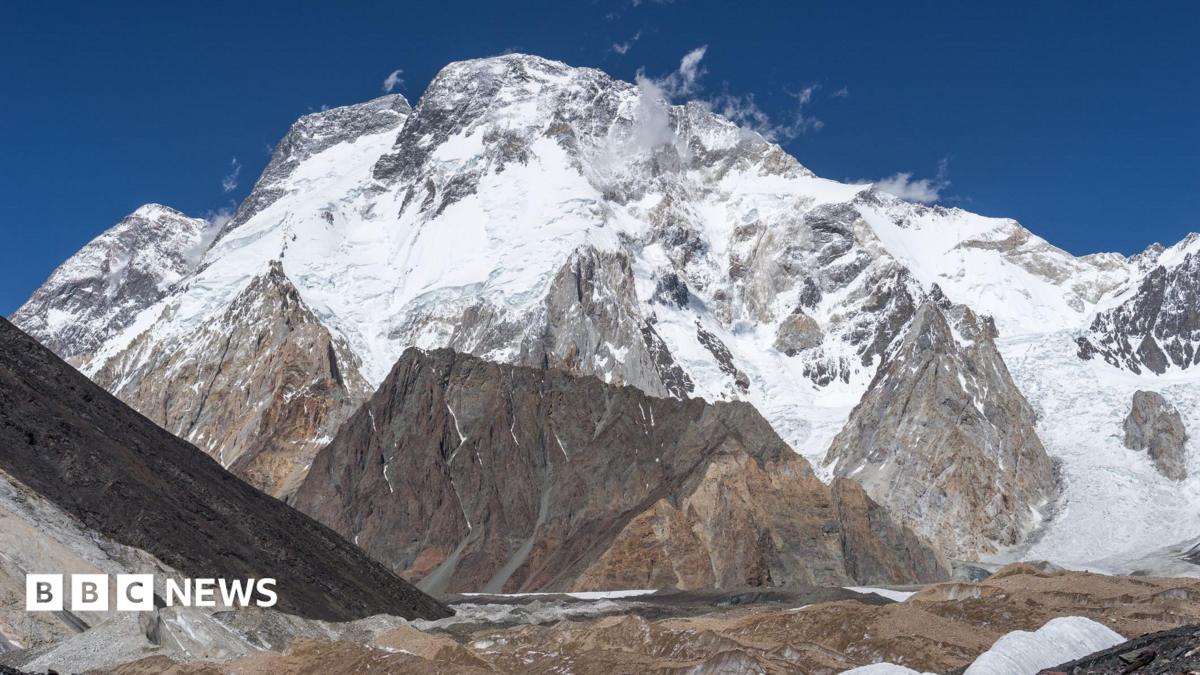
A search and rescue operation for the team began after reports an avalanche on Thursday on the 8,047-metre (26,400ft) peak in the Karakoram range.
The multinational climbing group was being led by renowned Nepal-born climber Nirmal Purja, the Alpine Club of Pakistan said.
He is known for climbing all 14 of the world’s 8,000-metre-plus mountains in just over six months in 2019.
The Alpine Club of Pakistan told the BBC it had seen movement from the GPS trackers of three members of the expedition, including Purja, but that a helicopter was unable to see anything at those locations.
Rescuers later found one of the trackers smashed, leading them to believe that the movement they had seen may have been a glitch.
The Alpine Club of Pakistan’s communications lead Naila Kiani said the chances of survival in such harsh conditions after more than 24 hours were “very slim”, but added that “miracles do happen”.
Earlier on Friday, the Alpine Club confirmed that two rescue helicopters had been sent by the Pakistan army, carrying rescue personnel and additional specialised equipment to support the rescue operation.
“The club prays for the safety and successful rescue of all the climbers and stands in solidarity with their families and the international mountaineering community during this difficult time,” it said.
Tragedy on Broad Peak: Inside the Avalanche That Shook the World of High-Altitude Mountaineering
A Mountain That Turned Deadly in Seconds
At around midday on Thursday, July 30, 2026, a wall of snow and ice broke loose on the upper slopes of Broad Peak, one of only fourteen mountains on Earth that rise above 8,000 metres. In the space of a few seconds, a routine — if always dangerous — summit push turned into one of the worst disasters in the modern history of Pakistani mountaineering. Ten climbers from five different countries were caught in the slide as they moved between Camp II and Camp III, at an altitude of roughly 6,580 metres. Among them was Nirmal “Nims Dai” Purja, arguably the most famous high-altitude climber alive today.
What followed was a chaotic, multi-day search-and-rescue effort hampered by bad weather, thin air, and a mountain that refused to give up its dead easily. By the weekend, only a handful of bodies had been recovered and identified, several more climbers had been spotted from the air but not yet reached, and the fate of at least one member of the expedition remained completely unknown. It is a story that has gripped the international climbing community — not only because of who was involved, but because of what it reveals about the risks that persist even for the most experienced mountaineers on the planet, and about how fragile the systems protecting them can be.
This article lays out what is known about the avalanche, the individuals involved, the geography and history of the mountain itself, and the broader context of high-altitude climbing that helps explain why an outing on one of the “easier” 8,000-metre peaks can still end in catastrophe.
Where and What Is Broad Peak?
Broad Peak sits in Pakistan’s Karakoram range, in the disputed Gilgit-Baltistan region near the country’s border with China, just a few kilometres from K2, the world’s second-highest mountain. At 8,047 metres (26,414 feet), Broad Peak is officially the twelfth-highest mountain on Earth, part of the exclusive group of fourteen “eight-thousanders” — peaks whose summits pierce above 8,000 metres, the altitude at which the human body can no longer physiologically adapt and instead begins to slowly die from oxygen deprivation, a zone climbers grimly call the “death zone.”
Compared with its infamous neighbour K2 — often nicknamed the “Savage Mountain” for its brutal technical difficulty and high fatality rate — Broad Peak has a reputation among professional climbers as a somewhat more approachable objective. Its standard route does not demand the same technical rock and ice climbing that make K2 so feared. That relative accessibility is precisely why it draws large international expeditions each summer, including commercial teams guiding paying clients toward an 8,000-metre summit. But “less technical” has never meant “safe.” Broad Peak’s slopes are prone to sudden, unpredictable weather shifts, heavy snow loading, and avalanche conditions that can develop with little warning, especially after a period of unusually heavy snowfall — conditions that, according to climbers who were on the mountain in the days before the disaster, had already prompted some teams to abandon their attempts and descend.
The mountain has claimed lives before. In 2013, three Iranian climbers died during their descent after reaching the summit. In 2021, during a rare winter expedition, Russian-American climber Alex Goldfarb died after pushing on alone in dangerous conditions despite his climbing partner’s attempts to persuade him to turn back. And Pakistan’s Karakoram range as a whole has a long, sobering history of catastrophe: the country’s worst modern mountaineering disaster occurred in 2008, when eleven climbers died in a single incident on K2 after a serac collapse triggered a chain of falls and stranded climbers above the mountain’s most dangerous section, the Bottleneck.
The Expedition and the Avalanche
The team caught in Thursday’s avalanche was a genuinely international group, reflecting how modern 8,000-metre expeditions are often multinational affairs organised by professional guiding outfits rather than single-nation mountaineering clubs. According to statements from the Alpine Club of Pakistan and reporting from Nepali and Pakistani officials, the ten-person team included five Nepalese climbers, a Pakistani climber, an Omani climber, an American climber, a Chinese climber, and one additional foreign national. Some reports describe the group as actually comprising several smaller teams that happened to be climbing the same route on the same day — a common occurrence on popular 8,000-metre routes during a short summer weather window, when dozens of climbers from different expeditions converge on the same fixed ropes and campsites.
Leading the largest of these groups was Nirmal Purja, the Nepal-born, British-based mountaineer who has become perhaps the single most recognisable figure in contemporary high-altitude climbing. Purja was reportedly climbing as part of his own guiding operation, Elite Exped, with Broad Peak added as what he described, in a social media post shortly before the climb, as a late addition to his season’s objectives. In that same post, climbers and journalists have noted, Purja wrote what amounted to a plea to the mountain itself: asking for “nothing but safe passage up and back down.”
The other climbers named in various official statements and news reports include Nepali mountaineers Pur Bahadur Gurung (known by the nickname “Yukta”), Kili Pemba Sherpa (“Kilu”), Nima Sherpa, Nawang Thindu Sherpa, and Gyalu Sherpa; Pakistani climber Sohail Sakhi, who was guiding an American client; Chinese climber Wang Zhong; Omani climber Nadhira Ahmed Abdullah Al Harthy; and the American climber, widely reported in US media as 39-year-old Mallory Geis of San Antonio, Texas.
According to the Alpine Club of Pakistan, the avalanche struck the group at around 9:20 a.m. local time on Thursday — notably earlier than initial reports suggested, which had placed the event closer to midday. Some accounts describe not a single slide but two nearly simultaneous avalanches sweeping the slope where the climbers were making their way toward the higher camps. Whatever the precise sequence, the result was the same: the entire ten-person team lost contact almost instantly, their satellite trackers and radios going silent at once.
A Painfully Slow Alarm
One of the most troubling details to emerge from the disaster is not about the avalanche itself, but about what happened — or rather, did not happen — in its immediate aftermath. Despite each expedition maintaining support staff at Base Camp, and despite other climbing teams being present in the area, word of the avalanche did not reach the Alpine Club of Pakistan until roughly 10 p.m. that night — nearly thirteen hours after the slide occurred.
“We only found out at 10 pm,” Naila Kiani, the Alpine Club of Pakistan’s communications lead, told the mountaineering outlet ExplorersWeb, adding: “We are all shocked.” That delay meant that the entire window of daylight on Thursday — the period in which a rapid helicopter response might conceivably have reached survivors before nightfall and plunging temperatures set in — was lost. In high-altitude rescue operations, where survival time for anyone trapped or exposed can be measured in hours, a thirteen-hour communication gap is close to catastrophic in itself, regardless of what caused it. Pakistani authorities and the Alpine Club have not yet offered a full public explanation for how such a significant event on a mountain with multiple expeditions and Base Camp staff went unreported for so long, though it is a question that is likely to be scrutinised closely once the rescue operation concludes.
The Search and Rescue Operation
Once alerted, Pakistani authorities moved quickly to organise a response, though they were immediately constrained by geography, altitude, and weather. The Pakistani government dispatched military helicopters, and the search and rescue effort came to involve a coalition of resources: the Alpine Club of Pakistan, the Pakistani Army, ground rescue teams, and — critically — other professional climbers already in the region who were recruited to assist, since few people in the world are as qualified to search a Karakoram avalanche site as the small community of elite high-altitude mountaineers who happened to be nearby.
Leading the on-the-ground search effort was Mingma Gyalje Sherpa, a highly respected Nepali mountaineer and expedition leader in his own right, whose team used drone footage to scan the debris field from the air. Ground teams, meanwhile, worked to physically reach the site, an undertaking complicated by the avalanche’s location on a steep, unstable slope at nearly 6,600 metres, itself well within the range where climbers require supplemental oxygen and acclimatisation to function safely.
The first confirmed news came on Thursday night and into Friday: four bodies had been located by ground rescue teams, though their identities could not immediately be confirmed. Some climbers who had been swept down the slope, rather than buried, were reportedly brought back to Base Camp through an overland recovery effort, and it was during that process that the first bodies were found. Poor weather — a recurring villain throughout this disaster — initially grounded helicopters altogether, forcing rescuers to rely on foot travel across dangerous, avalanche-prone terrain.
By Friday, two of the recovered bodies had been formally identified: Nepali climber Pur Bahadur Gurung and Omani climber Nadhira Al Harthy, whose remains were evacuated by helicopter to the city of Skardu, the main gateway town for Karakoram expeditions, for what officials described as the legal formalities required to confirm identification. Al Harthy’s death carries particular historical weight in Omani mountaineering circles: reports indicate she was the first Omani woman to attempt an 8,000-metre peak, making her loss a significant one for a country with only a small community of high-altitude climbers.
Later on Friday, American officials and US media confirmed that the remains of Mallory Geis, the 39-year-old climber from San Antonio, had also been recovered and identified among those brought down from the mountain. Geis had been climbing with Pakistani guide Sohail Sakhi as part of a smaller client-guide team within the larger multi-expedition group on the mountain that day.
The Alpine Club of Pakistan’s initial statements on the number of bodies located proved somewhat inconsistent in the first 24 to 48 hours — a common feature of disaster reporting in extremely remote, high-altitude environments where information has to be relayed by radio, satellite phone, or in-person messenger before it reaches officials able to speak to the media. At one point the club indicated four bodies had been found; this was later clarified to mean two full bodies and a body part, with additional figures spotted only via aerial drone survey and not yet physically reached or confirmed by ground teams. Officials cautioned that the condition and identity of those additional climbers could not be determined until search teams were able to physically access the site, a process expected to take several hours of difficult travel even once weather permitted.
The Search for Nirmal Purja
Throughout the operation, the fate of Nirmal Purja himself remained the most closely watched thread of the story, given his global profile. The Alpine Club of Pakistan reported that GPS trackers belonging to three members of the expedition, including Purja’s, had shown signs of movement after the avalanche — a detail that, for a brief period, offered a flicker of hope that some climbers might have survived and be moving, however slowly, through the debris field.
That hope was tempered, and ultimately undermined, once helicopters were able to fly over the coordinates in question and found no visible sign of the climbers at those locations. Rescuers later recovered one of the GPS trackers in a damaged, smashed condition, leading investigators to conclude that the “movement” picked up by the tracking system may have been nothing more than a technical glitch — the device tumbling or shifting within debris rather than genuine evidence of a climber moving under their own power.
Naila Kiani of the Alpine Club offered a blunt but carefully balanced assessment of the odds facing anyone still unaccounted for after more than 24 hours in such conditions: the chances of survival, she said, were “very slim” — though she added that “miracles do happen,” a sentiment echoed throughout the climbing world’s public statements of hope over the following days.
Purja’s disappearance has drawn an outsized share of global media attention, in part because of the scale of his prior achievements. Born in Myagdi, in Nepal’s Gandaki Province, in 1983, Purja spent years as a soldier in the British Army’s Brigade of Gurkhas before transitioning into the elite Special Boat Service, Britain’s naval special forces unit. He left military service in 2018 to pursue mountaineering full-time, and within a year had accomplished what much of the climbing establishment considered essentially impossible: summiting all fourteen of the world’s 8,000-metre peaks in just six months and six days, obliterating the previous record, which had taken the best part of eight years to achieve. His feat, chronicled in the acclaimed Netflix documentary “14 Peaks: Nothing Is Impossible,” turned him into a genuine celebrity well beyond the relatively small world of professional alpinism.
Purja did not stop there. He was part of the historic team that completed the first winter ascent of K2 in January 2021 — one of the last great unclaimed prizes in high-altitude mountaineering, achieved without supplemental oxygen by the full team. In the years since, he has continued to set records, including, according to some reports, becoming the fastest person to summit all fourteen 8,000-metre peaks without the use of supplemental oxygen, and has built Elite Exped into one of the most prominent commercial guiding operations working on the world’s highest mountains. Broad Peak itself was, in a striking twist of circumstance, one of the five peaks Purja summited during his historic 2019 record run — meaning that the very mountain that made his career now sits at the centre of the gravest crisis of it.
Reactions From Around the World
The scale of the disaster, and Purja’s global profile, prompted a wave of official statements and public reaction across the countries connected to the missing climbers. Nepal’s Ministry of Foreign Affairs said it was closely monitoring the situation, with the Nepali Embassy in Islamabad coordinating directly with Pakistani authorities, including the Alpine Club of Pakistan, to support what officials described as a swift and safe search-and-rescue effort for all affected climbers. Given that five of the ten climbers on the mountain were Nepali nationals, the disaster has been felt with particular intensity in Nepal, a country whose Sherpa and mountain-guiding communities form the backbone of commercial expeditions across the Himalaya and Karakoram alike, and whose climbers are disproportionately represented among the deaths and injuries that occur on the world’s highest peaks each year.
China’s government also weighed in, with Foreign Ministry spokeswoman Mao Ning stating that Beijing was “urgently working to verify and understand the situation” regarding Wang Zhong, the Chinese climber caught in the avalanche, and offering to provide assistance to Pakistan in the search-and-rescue effort.
The Alpine Club of Pakistan, which has served as the central coordinating and communicating body throughout the crisis, issued a statement expressing solidarity with the families of all those affected: “The club prays for the safety and successful rescue of all the climbers and stands in solidarity with their families and the international mountaineering community during this difficult time.”
Within the climbing world itself, the reaction has been one of shock tinged with a grim, familiar recognition. Mountaineering media outlets, expedition operators, and fellow climbers who have summited alongside Purja and the other members of the expedition have offered tributes and updates throughout the unfolding crisis, several noting the bitter irony that a mountain widely regarded as more forgiving than its neighbour K2 could still produce a disaster of this scale.
Understanding the “Death Zone” and Why 8,000-Metre Peaks Remain So Dangerous
To understand why an avalanche on a single day could kill or endanger an entire ten-person, multinational expedition, it helps to understand the physiological and environmental extremes at play above 8,000 metres. At that altitude, atmospheric pressure is roughly a third of what it is at sea level, meaning the human body takes in dramatically less oxygen with every breath. The body cannot acclimatise to this environment in any permanent sense; it can only survive there for limited periods before cognitive function, physical strength, and basic bodily systems begin to deteriorate — hence the grim nickname “death zone.”
Climbers operating above 8,000 metres, even with supplemental bottled oxygen, are working with severely compromised judgment, slowed reaction times, and bodies already pushed to their physiological limits by cold, exertion, and hypoxia. This is precisely why avalanches, rockfall, sudden weather changes, and crevasse falls are so much more lethal at extreme altitude than they might be lower on a mountain: climbers have far less physical and cognitive reserve to respond to an emergency, dig themselves or teammates out of snow, retreat to safety, or simply endure a night in the open while awaiting rescue.
Avalanche risk on 8,000-metre peaks is also notoriously difficult to predict with precision. Snowpack at extreme altitude is affected by wind loading, solar radiation, temperature swings between day and night, and the underlying glacial ice structure in ways that can differ significantly from lower-altitude avalanche terrain more familiar to backcountry skiers and climbers in ranges like the Alps or the Rockies. Local guides and expedition leaders rely heavily on experience, recent snowfall history, and observation of the slope’s behaviour — but even highly experienced operators, as this tragedy demonstrates, can be caught out by conditions that shift with little obvious warning.
Reporting from the days before the avalanche suggests exactly this kind of shifting risk picture on Broad Peak. Climbers in the area described a mountain whose mood had “dramatically changed” over the preceding weeks, following a period of heavy snowfall in late July. Some experienced mountaineers who had been on the peak’s slopes in the days before the disaster had already grown uneasy enough about conditions to call off their own summit attempts and descend, even as other teams — including Purja’s larger, later-arriving group — pushed onward. This divergence in judgment among experienced professionals, all looking at broadly the same mountain and broadly the same weather data, is itself a familiar and sobering pattern in high-altitude mountaineering disasters: hindsight tends to clarify risks that, in the moment, were genuinely ambiguous even to experts.
A History of Karakoram Disasters
Thursday’s avalanche joins a long and difficult history of mass-casualty incidents in the Karakoram range, a mountain system that, while containing fewer 8,000-metre peaks than the Himalaya, has in some ways an even more severe reputation among professional climbers for objective danger — meaning risks like avalanche, rockfall, and serac collapse that exist independent of a climber’s own skill or decision-making.
The single worst mountaineering disaster in Pakistan’s modern history remains the 2008 K2 catastrophe, in which eleven climbers from multiple expeditions died over roughly 48 hours after a serac — a massive, unstable block of glacial ice — collapsed above the mountain’s infamous Bottleneck section, sweeping away fixed ropes that dozens of climbers were relying on for their descent from the summit. That disaster, which unfolded across several international expeditions climbing simultaneously, exposed many of the same systemic vulnerabilities now being scrutinised in the wake of the Broad Peak avalanche: the risks of multiple independent teams converging on a single route and summit window, the reliance on shared fixed ropes and infrastructure that can fail catastrophically all at once, and the sheer difficulty of coordinating rescue efforts at altitudes where helicopters struggle to fly and rescuers themselves face life-threatening exposure.
Broad Peak’s own history includes the 2013 deaths of three Iranian climbers during their descent from the summit, and the 2021 death of Russian-American climber Alex Goldfarb during a winter expedition attempt, after he continued alone in dangerous conditions his climbing partner had urged him to abandon. Winter ascents of 8,000-metre peaks, a specialty in which Purja himself made history on K2 in 2021, represent an even more extreme subset of high-altitude climbing, conducted in conditions of profound cold and unpredictable weather that place climbers at heightened risk even by the standards of an already dangerous sport.
Taken together, this history underscores a pattern that mountaineering safety researchers have long observed: technical difficulty and overall danger are not the same thing. A mountain like Broad Peak, considered less technically demanding than K2, can still produce mass-casualty events driven by objective hazards like avalanches — hazards that no amount of individual climbing skill can fully mitigate, and which are becoming, according to many veteran Karakoram climbers and expedition operators, less predictable as changing weather patterns alter historical snowfall and temperature norms in the range.
The Commercialisation of 8,000-Metre Climbing
The Broad Peak disaster also arrives at a moment of significant change in high-altitude mountaineering as an industry. Over the past decade, the world’s fourteen 8,000-metre peaks have become increasingly accessible to paying clients through commercial guiding operations — companies, often founded and staffed by elite Sherpa and Nepali climbers, that offer supported expeditions complete with fixed ropes, stocked high camps, supplemental oxygen logistics, and experienced guides. This shift has dramatically increased the total number of people attempting these mountains each year, including climbers with less personal high-altitude experience than was typical in earlier decades of Himalayan and Karakoram mountaineering.
Purja’s own company, Elite Exped, is part of this broader commercial landscape, and the expedition caught in Thursday’s avalanche reflects its now-common structure: a mix of professional Nepali and Pakistani guides, elite climbers pursuing their own personal records, and paying clients — in this case reportedly including Mallory Geis, the American climber guided by Sohail Sakhi.
This commercialisation has been credited with opening up extreme mountaineering to a broader and more diverse range of participants, and with providing crucial economic opportunity to Nepali and Pakistani mountain communities whose guiding expertise underpins the entire industry. But it has also drawn scrutiny, particularly after high-casualty seasons on Everest and other popular peaks, over questions of route congestion, uneven experience levels among expedition members, and the pressure commercial operators may feel to push forward with summit attempts during narrow weather windows in order to satisfy client expectations and tightly scheduled itineraries. Whether any of these dynamics played a role in Thursday’s tragedy is not yet established, and officials investigating the disaster have not suggested that decision-making, rather than an unpredictable natural hazard, was to blame. But the incident is likely to reignite a debate within the climbing community that has been building for years, about how commercial expedition structures should adapt as more people than ever attempt the world’s most extreme mountains.
What Happens Next
As of the most recent updates from the Information Department of Gilgit-Baltistan and the Alpine Club of Pakistan, the operation remains active but incomplete. Three bodies have been positively identified — Mallory Geis of the United States, Nadhira Al Harthy of Oman, and Pur Bahadur Gurung of Nepal — and transported by helicopter to hospital facilities for formal identification procedures. Additional figures spotted by aerial drone survey have not yet been reached or identified, and the whereabouts of at least one climber remain completely unknown. Bad weather has continued to disrupt rescue operations intermittently, forcing search teams to wait for windows in which helicopters can safely fly and ground teams can safely traverse what remains a highly unstable, avalanche-prone slope.
Search efforts were set to resume as soon as conditions allowed, with rescue teams — drawing on Pakistani military helicopter support, the expertise of veteran Karakoram climbers like Mingma Gyalje Sherpa, and coordination from diplomatic missions representing the nationalities involved — continuing to work toward recovering and identifying every member of the expedition. For the families of those confirmed dead, and for the families still waiting for news of missing loved ones, the coming days are likely to bring a difficult combination of formal identification procedures, repatriation logistics, and the kind of prolonged uncertainty that has become tragically familiar to those connected to high-altitude mountaineering’s most dangerous seasons.
Whatever the final toll, the Broad Peak avalanche is already being discussed within the climbing world as one of the defining tragedies of this Karakoram season — a stark reminder that even the most decorated, best-prepared climbers, operating on a mountain considered less severe than its most notorious neighbour, remain at the mercy of forces no amount of skill, planning, or experience can fully control.
Sources consulted
This article draws on reporting and statements from the Alpine Club of Pakistan, the Information Department of Gilgit-Baltistan, Nepal’s Ministry of Culture, Tourism and Civil Aviation, and news coverage from CNN, Al Jazeera, the Kathmandu Post, ExplorersWeb, Planetmountain.com, National Geographic, and Gulf News, among others, current as of August 1, 2026. Details of the search-and-rescue operation remained fluid at time of writing, and figures regarding the number and identities of recovered climbers may be updated as officials complete formal identification procedures.