
Everything You Need to Know About Deductibles
Of all the numbers on your car insurance policy, the deductible might be the one that gets the least attention when people first sign up — and the most attention the moment they actually need to file a claim. It’s easy to pick a number when you’re just trying to get the lowest possible monthly payment. It’s a very different experience when you’re standing in a repair shop parking lot realizing exactly how much of that bill is coming out of your own pocket first.
This guide covers what a deductible actually is, the real trade-offs between choosing a low one and a high one, and — because the concept only really makes sense with numbers attached — several real-world examples showing how the math plays out in practice.
What a Deductible Actually Is
A deductible is the amount of money you agree to pay out of your own pocket before your insurance coverage starts paying for a covered claim. If you have a $500 deductible and your car sustains $3,000 in damage from a covered accident, you pay the first $500, and your insurer covers the remaining $2,500.
Deductibles typically apply to collision and comprehensive coverage — the parts of your policy that pay for damage to your own vehicle. Liability coverage, which pays for damage or injuries you cause to others, generally doesn’t involve a deductible at all, since that portion of your policy isn’t about repairing your own property.
Deductibles are usually chosen by you when you set up your policy, and they typically range from $250 on the low end up to $2,000 or more on the high end, though the exact options available depend on your insurer.
Low Deductible vs. High Deductible: The Core Trade-Off
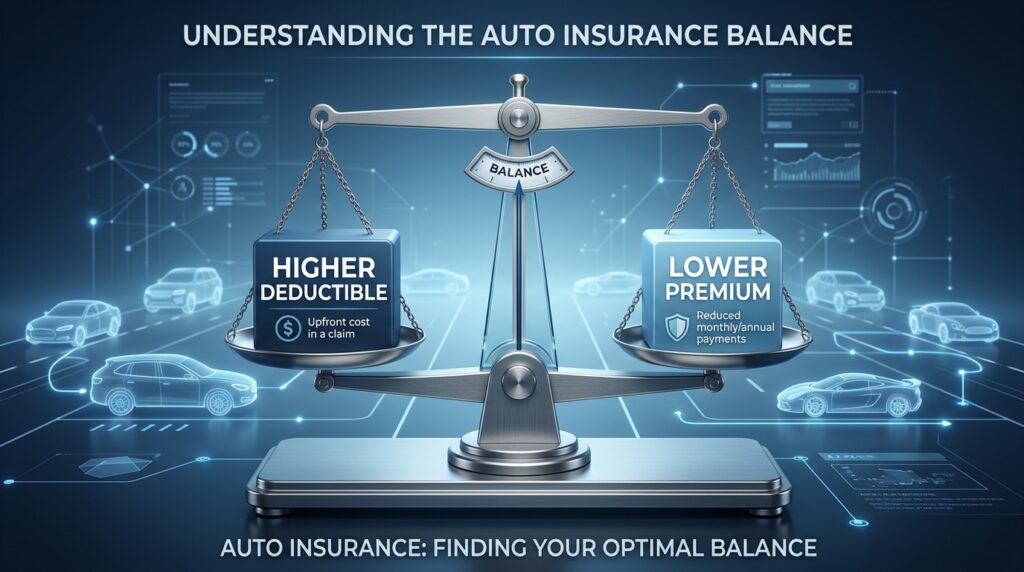
The relationship between your deductible and your premium is inverse: the lower your deductible, the higher your premium tends to be, and the higher your deductible, the lower your premium tends to be. This isn’t arbitrary — it directly reflects how much financial risk you’re keeping for yourself versus how much you’re transferring to the insurance company.
A low deductible means you’re paying more every month in exchange for paying less out of pocket if you ever file a claim. The insurer is taking on more of the risk, and they price that into your premium accordingly. This appeals to drivers who’d rather have predictable, smaller costs spread out over time than face a larger unexpected bill after an accident.
A high deductible means you’re paying less every month, but you’re agreeing to absorb a larger chunk of the cost yourself if something happens. The insurer is taking on less risk, since they know you’ll cover more of any claim before they step in, and your premium reflects that reduced exposure on their end.
Neither option is universally “better.” It genuinely depends on your financial situation, how often you’re likely to file a claim, and how much monthly savings versus emergency-fund security matters to you personally.
When a Low Deductible Makes Sense
You don’t have much in savings. If a sudden $1,500 repair bill would be a genuine hardship, a lower deductible protects you from that shock, even though you’re paying a bit more every month to get there.
You drive in high-risk conditions regularly. Frequent city driving, a long commute, a teenage driver on your policy, or living in an area with heavy traffic or severe weather all increase your statistical likelihood of needing to file a claim, which makes the lower out-of-pocket exposure more valuable.
You’re financing or leasing your vehicle. Lenders sometimes have specific requirements, and even where they don’t, a lower deductible can make sense simply because you have more financial exposure tied up in a car you don’t fully own yet.
Peace of mind matters more to you than maximizing savings. Some people are simply more comfortable knowing that if something happens, their out-of-pocket cost will be small and predictable, even if it means a slightly higher bill every month to get there. That’s a legitimate reason on its own.
When a High Deductible Makes Sense
You have a solid emergency fund. If you could comfortably pull $1,000 or $2,000 from savings without disrupting your finances, a higher deductible lets you pocket the premium savings month after month, essentially betting on your own ability to absorb an occasional larger cost.
You have a clean driving history and low claim frequency. If you rarely, if ever, file claims, a higher deductible means you’re consistently saving on your premium without the downside materializing very often, if at all.
Your vehicle isn’t worth very much. If your car’s value is low, the maximum payout you’d ever receive on a claim is capped by that value anyway, so a high deductible relative to the car’s worth doesn’t change your risk profile all that dramatically.
You’re specifically trying to lower your monthly costs. If cash flow is tight right now and you’re confident you could handle an occasional larger bill using a credit card or a short-term loan if absolutely necessary, a higher deductible is one of the most direct ways to bring your premium down without cutting your actual coverage limits.
Real Example 1: The Fender Bender
Two drivers each have $3,000 worth of damage to their vehicle after an accident that’s their fault.
Driver A has a $250 deductible and pays a monthly premium of $145. Driver B has a $1,000 deductible and pays a monthly premium of $110.
After the accident, Driver A pays $250 out of pocket, and insurance covers the remaining $2,750. Driver B pays $1,000 out of pocket, and insurance covers the remaining $2,000.
Over the course of a year, Driver A’s premium totals $1,740, while Driver B’s totals $1,320 — a $420 difference. Add in the claim: Driver A ends up paying $1,990 total for the year (premium plus deductible), while Driver B pays $2,320 total. In this specific scenario, the lower deductible actually worked out cheaper overall, but only because a claim was filed. If no accident had happened that year, Driver B would have come out $420 ahead simply from the lower premium.
This is the fundamental uncertainty at the heart of the deductible decision: you’re essentially betting on how likely you are to need your coverage during the policy period.
Real Example 2: The Multi-Year Comparison
Now imagine a driver who goes three years without filing a single claim, comparing a $500 deductible policy against a $1,500 deductible policy.
With the $500 deductible, they pay $135 a month, or $4,860 over three years. With the $1,500 deductible, they pay $105 a month, or $3,780 over three years.
Since no claim was filed during those three years, the driver with the higher deductible saved a full $1,080 simply by choosing the higher number and never needing to use it. This is exactly the scenario that makes high deductibles appealing for drivers with clean records: the savings compound every year a claim isn’t filed, and for many drivers, most years pass without one.
Real Example 3: The Total Loss Scenario
Consider a driver whose car, valued at $9,000, is totaled in an accident.
With a $500 deductible, their insurer pays out $8,500 toward the vehicle’s value. With a $2,000 deductible, their insurer pays out $7,000.
That’s a $1,500 difference in what the driver actually receives, directly tied to the deductible they chose. If this driver had been paying significantly less in premiums over the years specifically because of that higher deductible, the math might still favor the higher deductible overall — but it’s a useful reminder that in a total loss situation, the deductible comes directly out of your final payout, not just out of a repair bill.
Real Example 4: The Minor Claim Dilemma
A driver with a $1,000 deductible gets an estimate of $1,200 to repair minor damage after backing into a pole.
If they file a claim, insurance covers $200 of the $1,200 bill, since the deductible absorbs the first $1,000. But filing that claim could also affect their future premium at renewal, potentially costing more over the next few years than the $200 payout was worth in the first place.
In a case like this, many drivers choose to simply pay the full $1,200 out of pocket rather than filing a claim at all, avoiding both the deductible and any potential rate impact. This illustrates an important, often-overlooked point: your deductible isn’t just about what you pay when you file a claim — it’s also a useful benchmark for deciding whether filing is even worth it in the first place.
How to Decide What’s Right for You
A practical way to think about your deductible is to ask yourself two questions. First, if I had to pay this deductible amount tomorrow, out of nowhere, would it genuinely hurt my finances? If the honest answer is yes, lean toward a lower deductible, even if it costs more every month. If the answer is no, a higher deductible is likely a smart way to reduce your ongoing costs.
Second, how often have I actually filed claims in the past, realistically? If your history suggests you rarely file claims, a higher deductible tends to pay off over time, since you’re saving on premiums during all the years nothing happens. If your history — or your circumstances, like a new teen driver or a long, high-traffic commute — suggests claims are more likely, a lower deductible provides more predictable protection.
There’s no permanent right answer here, either. It’s worth revisiting your deductible periodically, especially after a significant change in your savings, your driving habits, or your overall financial situation, to make sure the number you chose years ago still reflects the trade-off you’d actually want to make today.