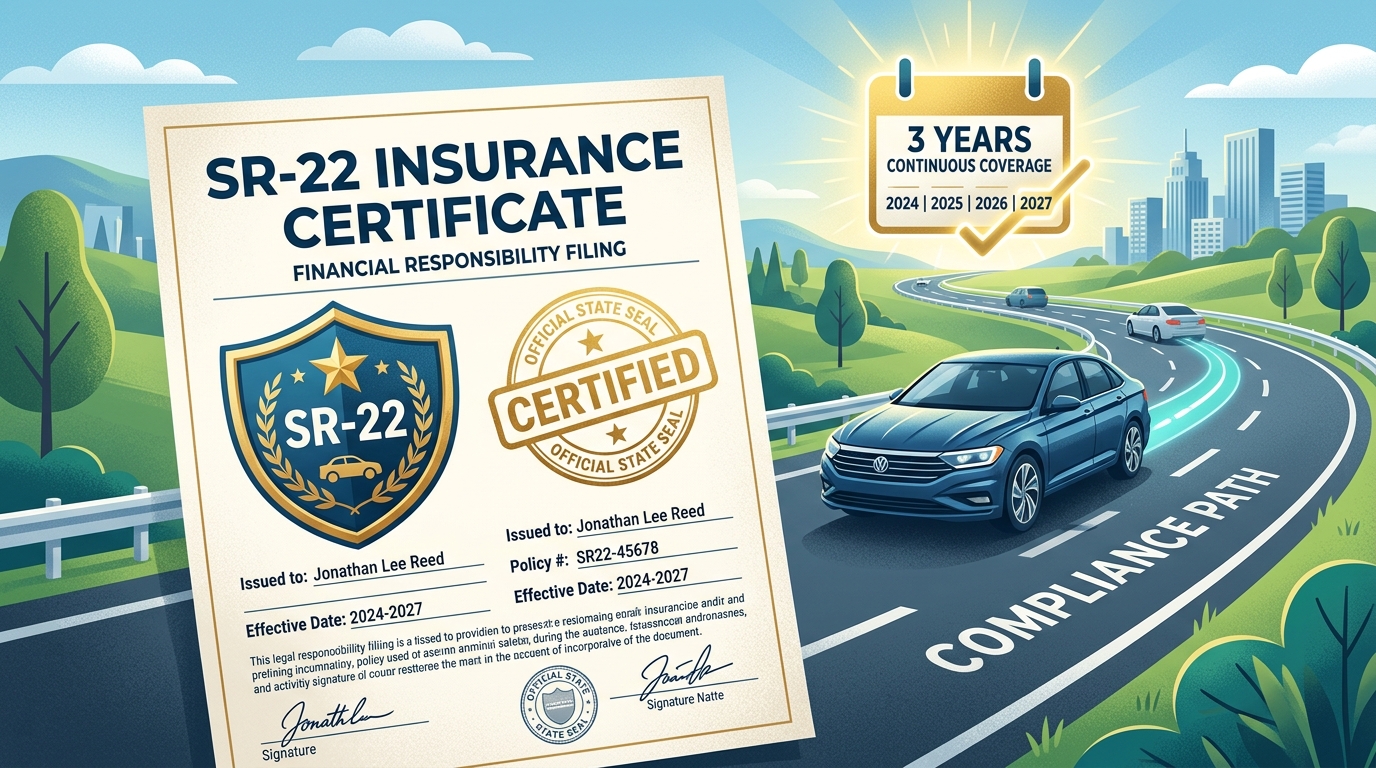
SR-22 Insurance Explained: Cheapest Providers and How Long You Need It
If you’ve been told you need SR-22 insurance, your first reaction was probably confusion followed by dread. The name sounds technical, the requirements seem mysterious, and the costs can feel overwhelming. But here’s the truth: SR-22 insurance is not actually insurance at all — it’s a certificate that proves you have insurance. Understanding this distinction is the first step toward navigating the process with confidence and finding the most affordable option for your situation.
Whether you’re dealing with a DUI, a lapse in coverage, or too many points on your driving record, this comprehensive guide will walk you through everything you need to know about SR-22 insurance in 2026. We’ll cover what it is, why you need it, how much it really costs, which providers offer the cheapest rates, and most importantly, how long you’ll have to carry it — because the answer varies significantly depending on where you live and what you did.
Chapter 1: What Exactly Is SR-22 Insurance?
The Most Common Misconception
Let’s clear this up right away: an SR-22 is not a type of insurance policy. It is a certificate — a form, really — that your insurance company files with your state’s Department of Motor Vehicles (DMV) to prove that you are carrying the minimum required liability insurance coverage.
Think of it as your insurance company vouching for you to the state. Your insurer is essentially saying, “Yes, this driver has the legally required coverage, and we promise to notify you if that coverage ever lapses or gets canceled.”
The term “SR-22 insurance” is commonly used as shorthand, but technically, you’re buying a standard auto insurance policy with an SR-22 filing attached to it.
What an SR-22 Actually Does
An SR-22 filing serves several important functions:
- It proves you have active car insurance that meets your state’s minimum requirements.
- It requires your insurance company to notify the DMV if your policy is canceled or lapses for any reason.
- It allows you to reinstate a suspended license or restore driving privileges after a violation.
The SR-22 is your ticket back to legal driving status. Without it, you cannot drive legally in most states.
Chapter 2: Why Would You Need an SR-22?
States require SR-22 filings when drivers demonstrate what they consider high-risk behavior. The logic is simple: if you’ve shown you’re a higher-than-average risk on the road, the state wants extra assurance that you’re carrying insurance before allowing you to drive again.
Common Triggers for an SR-22 Requirement
Here are the most frequent reasons drivers need an SR-22:
DUI or DWI Convictions — This is the most common trigger and often results in the longest filing periods. A single DUI typically requires three years of SR-22 filing in most states.
Driving Without Insurance — If you’re caught driving without the legally required coverage, many states will require an SR-22 to reinstate your license.
Too Many Points on Your Driving Record — Accumulate enough traffic violations, and your state may label you a high-risk driver requiring an SR-22.
At-Fault Accidents While Uninsured — If you cause an accident and don’t have insurance to cover the damages, an SR-22 is almost certain.
Reckless Driving Convictions — This serious violation often triggers an SR-22 requirement.
Driving with a Suspended License — Getting caught driving while suspended adds another layer of penalties.
Unpaid Child Support — In some states, failure to pay court-ordered child support can affect your driving privileges and trigger an SR-22 requirement.
States That Require SR-22
While most states use the SR-22 system, there are important exceptions:
- 31 states require SR-22 filings for high-risk drivers.
- 11 states have conditional requirements that vary based on the violation.
- 9 states do not require SR-22 filings at all.
Important Note: Florida and Virginia use a different system called FR-44 instead of SR-22. FR-44 requires significantly higher liability coverage limits — typically 100/300/50 compared to the standard 25/50/25 — making it substantially more expensive.
Chapter 3: How Long Do You Need SR-22 Insurance?
This is arguably the most critical question, and the answer is more nuanced than most people realize.
The Short Answer
Most drivers need to carry an SR-22 for three years, but the actual duration can range from one year to five years or more depending on your state and the severity of your offense.
The Long Answer: It Depends on Several Factors
Factor 1: Your State
The majority of states — roughly 35 — require a standard three-year SR-22 filing period for most violations. This includes California, Texas, Illinois, Ohio, and Georgia. (Note: New York uses an FS-1 form instead of an SR-22 but functions similarly.)
However, there are significant variations:
| State Group | Filing Period | Notable Details |
|---|---|---|
| CA, TX, IL, OH, GA | 3 years | Standard for DUI and uninsured driving |
| Alabama | 3 years | Standard minimum coverage 25/50/25 |
| Alaska | 3 years | Higher minimum coverage 50/100/25 |
| Arizona | 1-2 years | Shorter than most states |
| Arkansas | 3-20 years | Repeat offenses can extend dramatically |
| Colorado | 9 months – 3 years | Varies by offense |
| Georgia | 1 year | One of the shortest periods |
| Florida | 3 years | Uses FR-44 with higher limits |
Factor 2: The Severity of Your Offense
Not all violations are treated equally:
- First-time DUI: Typically 3 years in most states.
- Second DUI: Often pushes the requirement to 5 years.
- Driving without insurance: Generally carries a shorter filing period, though some states treat it as seriously as a DUI.
Alaska provides a stark example of how repeat offenses escalate requirements:
- First DUI: 5 years from the ending date of revocation
- Second DUI: 10 years from the ending date
- Third DUI: 20 years from the ending date
Factor 3: When the Clock Starts
Here’s something that trips people up constantly: your SR-22 filing period does not start when you get convicted or when the court orders it. It starts on the date your insurance company successfully files the SR-22 with your state’s DMV.
If you wait three months after your conviction to get your filing in order, you’ve just delayed your timeline by three months. The clock also resets if your coverage lapses at any point during the filing period.
Factor 4: Keeping Your Record Clean
During the filing period, any additional violations or coverage lapses can extend your requirement or reset the clock entirely.
Critical Warning: Don’t Let Your Policy Lapse
If your SR-22 policy lapses — even for one single day — your insurance company is legally required to notify the state (via an SR-26 filing). This triggers an immediate license suspension, and the required filing period may restart from scratch.
This is one of the most expensive mistakes you can make. A single day without coverage can cost you years of additional SR-22 requirements.
Chapter 4: How Much Does SR-22 Insurance Really Cost?
The Filing Fee vs. The Real Cost
There’s a significant difference between the filing fee and the actual cost of the insurance:
The SR-22 Filing Fee: This is a one-time charge of $15 to $50 that your insurance company adds to your policy to file the paperwork with the state.
The Insurance Premium: This is where the real cost lies. Your premiums will increase substantially because you’re now classified as a high-risk driver.
Average Costs in 2026
The cost of SR-22 insurance varies dramatically based on whether you own a vehicle:
| Policy Type | Average Monthly Cost | Average Annual Cost |
|---|---|---|
| Non-Owner SR-22 | $15-$30 | $180-$360 |
| Standard SR-22 (with vehicle) | $100-$450 | $1,200-$5,400 |
| Full Coverage with SR-22 (after DUI) | $210-$317 | $2,500-$3,800 |
The Premium Increase
An SR-22 requirement typically raises a driver’s premium by 20% to 60%, and in some cases by 50% to 300% depending on the severity of the violation and the insurer.
According to secondchanceinfo.com, a standard SR-22 policy with a vehicle costs $1,800 to $5,600 per year ($150-$450/month).
For drivers with a single DUI, the average annual cost for full coverage with an SR-22 in 2026 is $2,500 to $3,800 annually.
Chapter 5: Cheapest SR-22 Insurance Providers in 2026
Finding affordable SR-22 insurance requires shopping around. Rates vary by hundreds of dollars between insurers, and the cheapest option for one driver may not be the cheapest for you.
Top National Providers
Based on comprehensive analysis from WalletHub, Forbes Advisor, and other sources, here are the cheapest SR-22 insurance providers for 2026:
| Rank | Company | Avg. Monthly Rate | Best For | Key Notes |
|---|---|---|---|---|
| 1 | Progressive | ~$95-$120 | Overall best | Cheapest among major insurers according to Forbes Advisor; widely available nationwide |
| 2 | GEICO | ~$95-$136 | Competitive rates | WalletHub’s cheapest SR-22 company at $512/year |
| 3 | Erie | ~$114 | Regional affordability | Cheapest in states where available |
| 4 | Travelers | ~$150 | DUI drivers | Second-lowest costs for drivers requiring SR-22 after a DUI |
| 5 | State Farm | ~$110 | Agent support | Low complaints, decent pricing |
| 6 | AAA | Competitive | Members | One of the cheapest alongside GEICO |
| 7 | USAA | Affordable | Military members | Only available to active military, veterans, and families |
| 8 | Allstate | ~$120 | Liability coverage | Cheap liability option in some states |
| 9 | Shelter | Low complaints | Customer satisfaction | Very low complaint ratio |
Provider Details
Progressive — Forbes Advisor named Progressive the best overall for cheap SR-22 car insurance, earning a 5-star rating from their research team. It’s widely available nationwide and offers non-owner car insurance.
GEICO — WalletHub’s analysis found GEICO to be the cheapest car insurance company for drivers with an SR-22, with competitive rates of approximately $512 per year and generous discounts. GEICO also offers non-owner insurance for SR-22 drivers who don’t own a vehicle.
Erie Insurance — According to 2026 data, Erie Insurance averages $114 per month, making it the cheapest provider in states where it operates.
Travelers — Travelers offers the second-lowest costs for drivers who require SR-22 insurance after a DUI, and it also has excellent rates for drivers with a clean record who may be insured on the same policy.
Regional and Local Insurers
Don’t overlook smaller or regional insurers. According to WalletHub, local insurers such as Wawanesa (California), Country Financial, and Hastings Mutual often have the cheapest SR-22 insurance rates in certain states.
The Cheapest Option: Non-Owner SR-22
If you don’t own a vehicle, a non-owner SR-22 policy is by far the cheapest way to satisfy the requirement. These policies typically cost $15 to $30 per month ($180-$360/year) compared to $100-$450/month for a standard SR-22 policy with a vehicle.
A non-owner SR-22 provides liability coverage when you drive a vehicle you don’t own, and it follows you as the driver rather than being attached to a specific vehicle.
Major insurers offering non-owner SR-22 policies include Progressive, GEICO, State Farm, National General, Dairyland, and The General.
Chapter 6: SR-22 by State — Requirements and Duration
Here’s a detailed breakdown of SR-22 requirements across the United States:
| State | Status | Form | Filing Period | Minimum Coverage |
|---|---|---|---|---|
| Alabama | Required | SR-22 | 3 years | 25/50/25 |
| Alaska | Required | SR-22 | 3 years | 50/100/25 |
| Arizona | Required | SR-22 | 1-2 years | 25/50/15 |
| Arkansas | Conditional | SR-22 | 3-20 years | 25/50/25 |
| California | Required | SR-22 | 3 years | 15/30/5 |
| Colorado | Required | SR-22 | 9mo-3yr | 25/50/15 |
| Connecticut | Conditional | SR-22 | Varies | 25/50/25 |
| Delaware | Conditional | SR-22 | 3 years | 25/50/10 |
| DC | Required | SR-22 | 3 years | 25/50/10 |
| Florida | Required | FR-44 | 3 years | 100/300/50 |
| Georgia | Required | SR-22 | 1 year | 25/50/25 |
| Hawaii | Required | SR-22 | 3 years | 20/40/10 |
| Idaho | Required | SR-22 | 3 years | 25/50/15 |
| Illinois | Conditional | SR-22 | 3 years | 25/50/20 |
Minimum Coverage Explained
The numbers (like 25/50/25) represent your liability coverage limits:
- First number (25): $25,000 per person for bodily injury
- Second number (50): $50,000 per accident for bodily injury
- Third number (25): $25,000 for property damage
Florida’s FR-44 requires 100/300/50 — significantly higher coverage that makes it more expensive.
Chapter 7: How to Get SR-22 Insurance — Step by Step
The process is straightforward once you understand it:
Step 1: Contact an Insurance Company
Not all insurance companies offer SR-22 filings. You may need a high-risk insurance provider. You typically need to call directly rather than applying online.
Step 2: Purchase a Qualifying Policy
Your policy must meet:
- Your state’s minimum liability requirements
- Any court-ordered coverage requirements
Step 3: Pay the SR-22 Filing Fee
Most companies charge a one-time fee of $15 to $50 to file the paperwork.
Step 4: Insurance Company Files the SR-22
Your insurer electronically files the SR-22 form with the DMV. Some providers can get filings processed the same day, often within minutes.
Step 5: Reinstate Your License
Once the DMV receives the SR-22, you may be eligible to reinstate your driver license and restore driving privileges. Additional reinstatement fees (typically $25 to $500) may apply.
Chapter 8: Non-Owner SR-22 — The Affordable Alternative
What Is Non-Owner SR-22?
A non-owner SR-22 combines two things:
- A non-owner auto insurance policy — Provides liability coverage when you drive a vehicle you don’t own
- An SR-22 certificate — Filed with the state proving you carry minimum liability coverage
Who Needs Non-Owner SR-22?
You qualify for a non-owner SR-22 if:
- Your license was suspended (for DUI, driving without insurance, too many points, etc.)
- Your state requires an SR-22 to reinstate it
- You do not currently own a vehicle
Even if you don’t plan to drive, many states require you to maintain an SR-22 for the full filing period (usually 3 years) to keep your license valid.
Cost Comparison
| Item | Cost | Notes |
|---|---|---|
| Non-Owner SR-22 Policy | $15-$30/month | Liability-only; cheapest way to satisfy SR-22 |
| Standard SR-22 (with vehicle) | $100-$450/month | Covers your own vehicle |
| SR-22 Filing Fee | $15-$25 one-time | Fee your insurer charges |
| License Reinstatement Fee | $25-$500 | Separate state DMV fee |
Chapter 9: How to Save Money on SR-22 Insurance
1. Shop Around and Compare Quotes
Rates vary by hundreds of dollars between insurers. Get quotes from at least three to five companies.
2. Consider Non-Owner SR-22
If you don’t own a vehicle, a non-owner policy is 5 to 15 times cheaper than a standard SR-22 policy with a vehicle.
3. Stay with Your Current Insurer
If your current insurer will keep you and file an SR-22, staying is usually cheaper than switching. You’ll skip a new policy setup fee and avoid any coverage gap.
4. Ask About Discounts
Even as a high-risk driver, you may qualify for:
- Multi-policy discounts (bundling with home or renters insurance)
- Defensive driving course discounts
- Low mileage discounts
- Good student discounts (if applicable)
5. Maintain Continuous Coverage
Never let your policy lapse. A single day without coverage resets your SR-22 clock and triggers license suspension.
6. Improve Your Driving Record
Any additional violations during your SR-22 period can extend your requirement or increase your rates.
7. Consider Raising Your Deductible
If you have comprehensive or collision coverage, raising your deductible can lower your monthly premium.
Chapter 10: Frequently Asked Questions
Is SR-22 the same as regular car insurance?
No. An SR-22 is a certificate filed with your state proving you have insurance. You still need to purchase a regular auto insurance policy — the SR-22 is simply attached to it.
How long does an SR-22 stay on your record?
The SR-22 filing itself stays on your record for as long as your state requires — typically 1-5 years. However, the underlying violation (like a DUI) may remain on your driving record for much longer.
Can I get SR-22 insurance without a car?
Yes. A non-owner SR-22 policy provides liability coverage when you drive vehicles you don’t own.
What happens if I cancel my SR-22 insurance?
If you cancel your policy before the required filing period ends, your insurer will notify the state (via an SR-26 filing). Your license will be re-suspended, and the filing period may restart.
Does SR-22 insurance cover rental cars?
Non-owner SR-22 policies typically cover rental cars, but you should confirm with your insurer. Standard policies may or may not extend to rentals.
Can I switch insurance companies while I have an SR-22?
Yes, but you must ensure the new company files a new SR-22 with the state before canceling your old policy. Any gap in coverage resets your timeline.
How much does the SR-22 filing fee cost?
Most companies charge $15 to $50 as a one-time filing fee.
Does every state require SR-22?
No. While most states require SR-22, some use alternatives like FR-44 (Florida and Virginia), and a few states don’t require SR-22 at all.
What’s the difference between SR-22 and FR-44?
FR-44 is used in Florida and Virginia for serious DUI convictions. It requires significantly higher liability coverage limits — typically 100/300/50 compared to the standard 25/50/25 — making it more expensive.
Chapter 11: Common Mistakes to Avoid
Mistake 1: Thinking the Filing Fee Is the Only Cost
The $15-$50 filing fee is negligible compared to the premium increase. Plan for significant monthly increases.
Mistake 2: Letting Your Policy Lapse
Even one day without coverage resets your SR-22 clock and triggers license suspension. This is the most expensive mistake you can make.
Mistake 3: Waiting to File
Your filing period doesn’t start until the SR-22 is actually filed with the DMV. Every day you wait extends your requirement.
Mistake 4: Not Shopping Around
Rates vary by hundreds of dollars. The first quote you get is unlikely to be the cheapest.
Mistake 5: Assuming You Need Full Coverage
If your vehicle is paid off, you may only need liability coverage to satisfy the SR-22 requirement. Full coverage is more expensive.
Mistake 6: Not Understanding Your State’s Specific Requirements
Minimum coverage, filing periods, and even the form name vary by state. Know your state’s specific rules.
Conclusion: Your Path Forward
Being told you need SR-22 insurance can feel overwhelming, but it doesn’t have to be a financial disaster. With the right approach, you can find affordable coverage and satisfy your state’s requirements without breaking the bank.
Key Takeaways:
- SR-22 is a certificate, not insurance — you still need a standard auto policy.
- Most states require 3 years of SR-22 filing, but periods range from 1 to 5+ years.
- The filing fee is only $15-$50, but premium increases are substantial.
- Progressive, GEICO, and Erie offer the cheapest SR-22 rates in 2026.
- Non-owner SR-22 is 5-15 times cheaper than a standard policy if you don’t own a vehicle.
- Never let your policy lapse — even one day resets your timeline.
The most important step is to shop around. Rates vary by hundreds of dollars between insurers, and the cheapest option for one driver may not be the cheapest for you. Get quotes from multiple providers, ask about discounts, and don’t overlook non-owner policies if you don’t own a vehicle.
Your SR-22 requirement is temporary. With careful planning and the right provider, you can get through it with minimal financial pain and get back to driving legally and confidently.
Disclaimer: Rates, requirements, and filing periods are based on publicly available data from Forbes Advisor, WalletHub, Insurify, secondchanceinfo.com, sr22direct.com, and other sources as of 2026. Actual quotes and requirements may vary based on individual driver profiles, location, specific violations, and state regulations. Always verify requirements with your state’s DMV and compare multiple quotes before making a decision.