Full Coverage vs. Liability Insurance: Which One Should You Choose?
If you’ve ever gotten an insurance quote, you’ve probably seen two very different numbers side by side: a smaller one labeled “liability only” and a considerably larger one labeled “full coverage.” The gap between them can be tempting, especially if you’re trying to trim your monthly budget. But choosing between the two isn’t really about which one is cheaper — it’s about which one actually protects you given your specific situation.
This guide breaks down what each option really covers, walks through realistic scenarios showing how the choice plays out financially, and helps you figure out which one makes sense for your circumstances.
What Liability Insurance Actually Covers
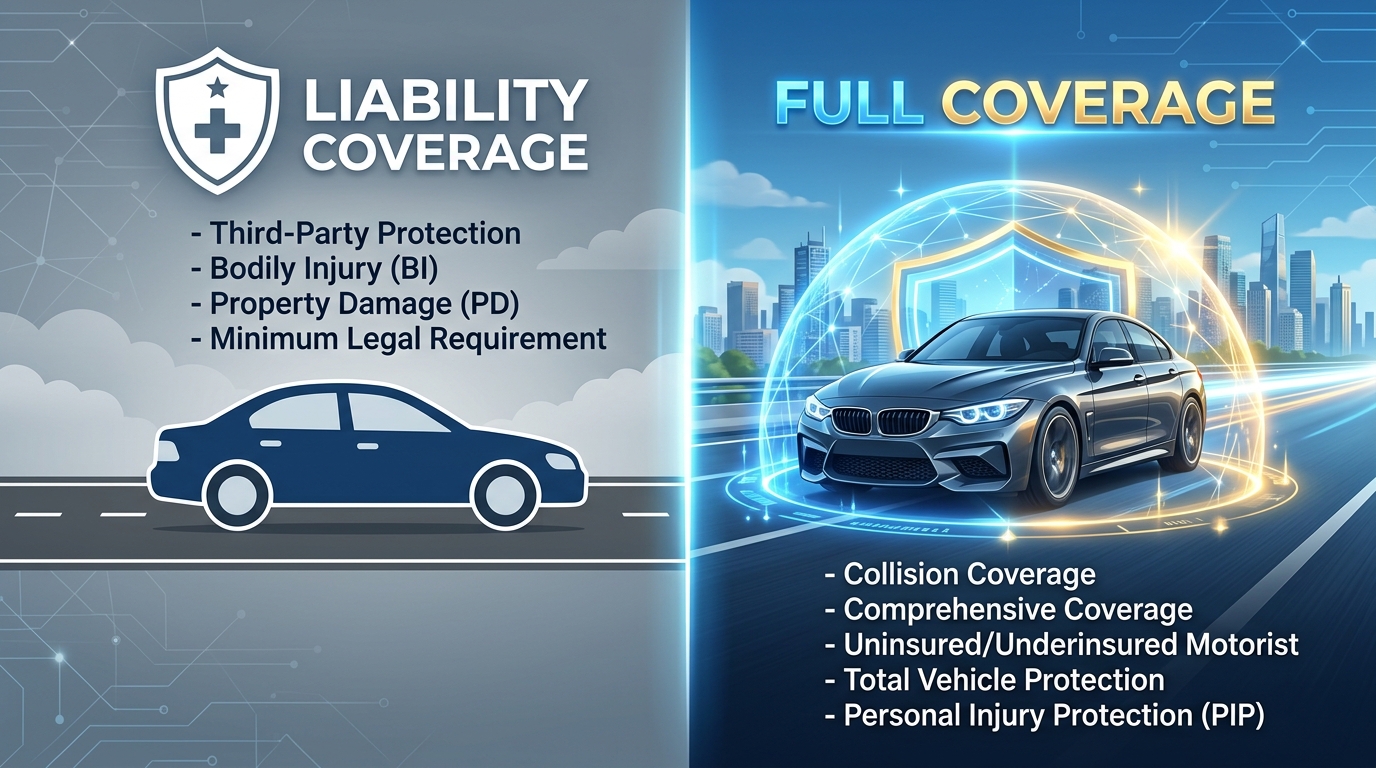
Liability insurance is the coverage almost every state or region requires simply to legally drive. It has two parts: bodily injury liability, which pays for the medical expenses, lost wages, and legal costs of other people if you injure them in an accident you caused, and property damage liability, which pays to repair or replace someone else’s vehicle or property that you damaged.
Here’s the part that catches a lot of people off guard: liability insurance does not pay for your own injuries or your own vehicle’s damage, under any circumstances. If you cause an accident, liability coverage takes care of the other driver and their car. Your car and your medical bills are entirely your responsibility unless you have separate coverage for them.
What Full Coverage Actually Means
“Full coverage” isn’t an official insurance term — you won’t find a policy literally called that — but it’s shorthand for a package that combines liability insurance with collision coverage and comprehensive coverage. Collision pays for damage to your own vehicle after a crash, regardless of who’s at fault. Comprehensive pays for damage from things other than a collision, like theft, vandalism, fire, hail, flooding, or hitting an animal.
Put simply, full coverage protects both sides of an accident: the other person’s losses through liability, and your own vehicle’s damage through collision and comprehensive. It’s the closest thing to complete protection for your car, though even full coverage typically excludes things like normal wear and tear or mechanical breakdowns unrelated to an accident.
Real-World Example 1: The Minor Fender Bender
Imagine two drivers, both with ten-year-old sedans worth around $4,000. Driver A carries liability-only coverage. Driver B carries full coverage with a $500 deductible.
Both drivers rear-end another car at a stop sign, causing $3,000 in damage to the other vehicle and $2,500 in damage to their own car.
Driver A’s liability insurance covers the $3,000 owed to the other driver. But the $2,500 needed to repair their own car comes entirely out of pocket, since liability doesn’t touch their own vehicle.
Driver B’s liability coverage also pays the $3,000 to the other driver. For their own car, they pay the $500 deductible, and their collision coverage picks up the remaining $2,000.
In this scenario, Driver B walks away $2,000 better off financially, even after accounting for the deductible — assuming their full coverage premium wasn’t costing them more than that difference over the course of the policy.
Real-World Example 2: The Older, Low-Value Car
Now picture a driver with a fifteen-year-old car worth about $1,800 on the used market. They’re deciding whether to keep paying for full coverage or switch to liability-only to save on their monthly premium.
Say their full coverage costs $80 more per month than liability-only — that’s $960 a year in extra premium. If that car were totaled in an accident, collision coverage would only pay out its actual cash value, roughly $1,800, minus the deductible, maybe $500, leaving a payout of about $1,300.
Over roughly a year and a half of paying that extra $80 a month, this driver would have spent more on the full coverage premium than the car itself is worth. In a case like this, dropping collision and comprehensive coverage and banking the difference in a personal savings account often makes more financial sense than continuing to insure a car for more than it’s actually worth.
Real-World Example 3: The Financed New Car
Consider a driver who just financed a new car worth $32,000. They’re tempted to save money by choosing liability-only coverage to keep their monthly payments down.
Here’s the problem: virtually every lender requires full coverage, specifically collision and comprehensive, for as long as the car is financed, because the lender has a financial stake in the vehicle until the loan is paid off. Liability-only simply isn’t an option in this situation — it’s not legal under the terms of most auto loans, not just inadvisable.
Even setting the lender requirement aside, if this driver total their new car in an at-fault accident with only liability coverage, they’d still owe the full remaining loan balance with nothing to show for it, since liability doesn’t reimburse them for their own vehicle at all. Full coverage, and often gap insurance on top of it, is essential here — not optional.
Real-World Example 4: The Weather-Prone Region
Picture a driver living in an area that regularly experiences hailstorms and flash flooding. Their car is paid off, worth about $12,000, and they’re weighing whether comprehensive coverage — the part of full coverage that handles non-collision events like hail and flood damage — is worth keeping even though the car has no loan attached to it.
A single serious hailstorm can cause several thousand dollars in dents and cracked glass across a vehicle. Without comprehensive coverage, this driver would be paying for that repair entirely out of pocket, even though the damage had nothing to do with their driving. Given the region’s weather patterns, keeping comprehensive coverage — even without collision — often makes sense here as a middle ground between full coverage and liability-only.
So, Which One Should You Choose?
There’s no universal right answer, but a few clear signals can point you in the right direction.
Choose full coverage if:
- You’re still financing or leasing your vehicle (this is often mandatory, not optional)
- Your car is worth more than roughly one to two years of the extra premium you’d pay for full coverage
- You couldn’t comfortably afford to repair or replace your car out of pocket if it were damaged or totaled
- You live in an area prone to severe weather, high theft rates, or heavy traffic
Consider liability-only if:
- Your car is paid off and its resale value is low relative to what full coverage would cost you annually
- You have enough savings to comfortably replace or repair the car yourself if something happened
- You’re comfortable accepting the risk of paying out of pocket for your own vehicle’s damage in exchange for a lower monthly premium
A useful gut check is what’s sometimes called the “10 percent rule”: if your annual full coverage premium is more than about 10 percent of your car’s actual value, it may be time to reconsider whether that coverage is still worth carrying. It’s not a hard rule, but it’s a reasonable starting point for a conversation with yourself — or your insurance agent — about what makes sense at this point in your car’s life.
A Middle Ground Worth Knowing About
If liability-only feels too risky but full coverage feels like more than you need, remember that collision and comprehensive coverage don’t have to be an all-or-nothing package. As shown in the hailstorm example above, some drivers choose to carry comprehensive coverage — which is often fairly inexpensive — while dropping collision, especially once their car’s value has dropped enough that a collision payout wouldn’t be very large anyway. This gives you protection against theft, weather, and other non-collision risks without paying for the more expensive collision piece.

Final Thoughts
The choice between full coverage and liability insurance really comes down to one question: if something happened to your car tomorrow, could you absorb that cost yourself, and would it be worth it to keep paying more each month to avoid that risk? For a financed vehicle or a car you genuinely couldn’t afford to replace, full coverage isn’t really optional — it’s a safety net that matches the financial stakes. For an older, low-value car with no loan attached, liability-only, or a partial middle ground like comprehensive-only, might be the financially smarter move.
Whichever direction you lean, it’s worth running the numbers on your own vehicle rather than defaulting to whatever you chose when you first bought the car. Values change, premiums change, and what made sense a few years ago might not make sense today.