Best Car Insurance for High-Risk Drivers in 2026: Full Comparison Guide
Being labeled a “high-risk driver” by an insurance company doesn’t necessarily mean you’re reckless behind the wheel. It’s an actuarial classification, not a character judgment — and it can happen to responsible drivers for reasons that have nothing to do with how careful they actually are. A single at-fault accident, a lapse in coverage while switching jobs, a speeding ticket from years ago that hasn’t aged off your record yet, or simply being a newly licensed teenager can all push you into the high-risk category and dramatically change what you pay for coverage.
The frustrating part is that once you’re classified this way, standard insurers often either decline to cover you or quote premiums that feel punishing. But high-risk doesn’t mean uninsurable, and it doesn’t mean you’re stuck paying the highest price on the market forever. Certain insurers specialize in — and in some cases actively compete for — high-risk drivers, and understanding how this part of the market works can save you a meaningful amount of money while you rebuild toward a cleaner record.
This guide walks through what actually makes a driver “high-risk” in an insurer’s eyes, how those insurers price risk differently from standard carriers, what to look for when comparing policies, and the practical steps that move you out of the high-risk category faster.
What Actually Makes You a “High-Risk” Driver
Insurance companies use the term “high-risk” to describe any driver whose statistical likelihood of filing a claim is meaningfully above average. The classification isn’t arbitrary — it’s built from a combination of factors that actuaries have found correlate with claim frequency and severity. The most common triggers include:
At-fault accidents. A single at-fault accident, especially one involving injury or significant property damage, can raise your risk classification for several years, even if it was an isolated incident in an otherwise clean history.
Traffic violations. Speeding tickets, reckless driving citations, and especially DUI or DWI convictions are among the heaviest weights in a risk model. A DUI in particular can push a driver into the highest risk tier available, often requiring specialized coverage just to stay legally insured.
Lapses in coverage. Letting your policy lapse — even briefly, even unintentionally during a move or a switch between insurers — signals inconsistency to underwriters and can raise your rate even if nothing else about your driving has changed.
Being a new or young driver. Teenagers and drivers in their late teens through early twenties are statistically more likely to be involved in accidents, simply due to inexperience behind the wheel, which places them in a higher-risk bracket regardless of individual driving quality.
Poor credit-based insurance score. In states where this factor is permitted, a low credit-based score can contribute to a high-risk classification, since actuarial data has historically linked credit history to claims likelihood.
Filing multiple claims in a short period. Even claims that weren’t your fault can sometimes contribute to a risk reclassification, depending on the insurer’s specific underwriting rules.
Driving a high-performance or frequently-stolen vehicle. The car itself factors into the equation — certain makes and models carry higher theft rates or higher repair costs, which can push even a spotless driver’s premium upward.
Understanding which of these factors applies to your specific situation is the first step, because different high-risk categories are served by different specialized insurers, and some companies are meaningfully better than others at pricing specific types of risk.
How High-Risk Insurance Actually Works
When a standard insurer views your profile as too risky, one of three things typically happens: they decline to offer you a policy at all, they offer one at a significantly elevated rate, or they refer you toward a nonstandard or specialty carrier built specifically to serve higher-risk drivers.
Nonstandard insurers operate on a fundamentally different pricing model than mainstream carriers. Rather than trying to attract the lowest-risk customers with the cheapest possible rates, these companies build their entire business around accurately pricing higher-risk profiles, charging more than a standard policy would but often significantly less than what a mainstream insurer would charge the same driver — if that mainstream insurer would even offer coverage at all.
Many states also maintain what’s known as an assigned risk plan or a shared market pool — essentially a last-resort mechanism ensuring that even drivers who can’t get coverage anywhere else can still meet the legal requirement to carry insurance. These plans are generally the most expensive option available and are worth using only if no standard or nonstandard insurer will write a policy for you directly.
The good news is that the nonstandard insurance market has grown substantially, and today there’s real competition among carriers that specialize in high-risk drivers, which means shopping around within this category matters just as much as it does in the standard market — arguably more, given how much rates can vary between specialty insurers for the exact same risk profile.
What SR-22 and FR-44 Filings Mean for Your Coverage
If your high-risk classification stems from a serious violation — a DUI, a reckless driving conviction, driving without insurance, or accumulating too many points on your license — your state may require you to carry an SR-22 or FR-44 filing as a condition of keeping your license valid.
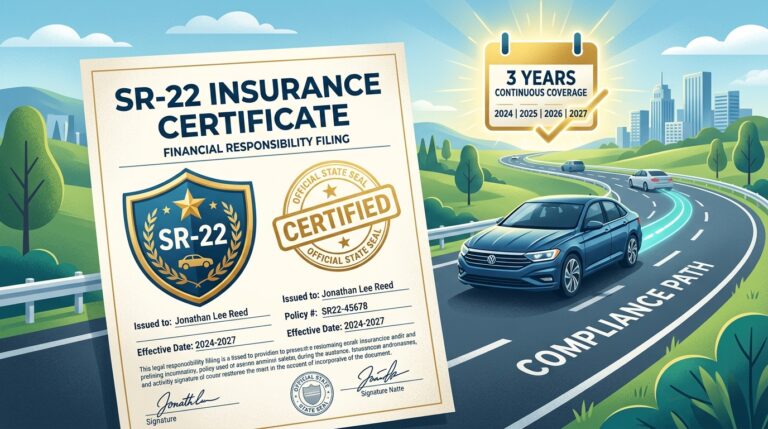
An SR-22 isn’t actually an insurance policy; it’s a certificate your insurer files with the state confirming that you carry the state’s minimum required liability coverage. An FR-44 serves a similar purpose in the handful of states that use it, typically requiring higher minimum liability limits than a standard SR-22. Not every insurer offers SR-22 or FR-44 filings, which is one of the key factors that narrows down which companies are even an option for drivers in this situation.
The filing itself usually carries a modest one-time or annual fee, separate from your actual premium — but it’s the underlying violation, not the filing itself, that drives most of the cost increase. It’s worth confirming directly with your state’s department of motor vehicles how long you’re required to maintain the filing, since letting it lapse even briefly can restart the clock or result in license suspension.
Key Factors to Compare When Shopping as a High-Risk Driver
Comparing policies as a high-risk driver requires a slightly different approach than standard shopping, because price alone can be misleading if it comes attached to weaker service or narrower coverage. Here’s what actually matters most:
Whether the insurer specializes in your specific risk category. A company that’s genuinely strong at pricing DUI-related risk isn’t necessarily the best option for a driver whose high-risk status comes from being newly licensed. Look for insurers with a demonstrated track record in your specific situation rather than assuming all “nonstandard” carriers are interchangeable.
SR-22/FR-44 filing support. If you need one of these filings, confirm upfront that the insurer offers it in your state and understand exactly how quickly they can file it, since delays can create legal complications.
Rate trajectory over time, not just the first-year price. Many high-risk insurers offer meaningful discounts for maintaining a clean record over subsequent renewal periods. Ask directly how your rate is likely to change at each renewal if you maintain a clean record, since the true cost of high-risk coverage is better measured over two or three years than in a single snapshot quote.
Payment plan flexibility. High-risk premiums are often paid in installments rather than a single annual lump sum, and the fees attached to those installment plans vary significantly between insurers. A slightly higher quoted premium with no installment fees can sometimes beat a lower quote loaded with monthly processing charges.
Claims handling reputation. Specialty insurers vary widely in how smoothly they handle claims. Checking third-party complaint ratios and customer reviews matters more here than in the standard market, since some nonstandard carriers are known for slower or more difficult claims processes.
Path back to standard coverage. Ask directly whether the insurer will proactively re-evaluate your rate and potentially move you toward standard coverage as violations age off your record, or whether you’ll need to shop around again yourself once you’re no longer classified as high-risk.
Categories of High-Risk Drivers and What Tends to Work Best for Each
Drivers with a DUI or DWI conviction typically face the steepest rate increases of any category and almost always need SR-22 or FR-44 filing support. Insurers that specialize in this exact situation tend to have more competitive pricing than generalist nonstandard carriers, since they’ve built underwriting models specifically around this risk profile and its typical trajectory back toward standard rates over several years of clean driving.
Newly licensed and teen drivers are high-risk purely due to inexperience rather than any negative history. For this group, the most effective savings lever isn’t necessarily finding a specialty high-risk insurer — it’s staying on a parent’s or guardian’s existing policy as an added driver where possible, combined with defensive driving courses, good student discounts, and telematics programs that can demonstrate safe habits quickly and accelerate the path to standard rates.
Drivers with multiple at-fault accidents benefit most from insurers that weight recency heavily, since a cluster of accidents from several years ago should matter less over time than the same driver’s more recent record. Comparing quotes annually is especially valuable here, since the rate impact of older incidents diminishes at different speeds across different companies.
Drivers with a coverage lapse — often the result of a job loss, a move, or simply forgetting a renewal — are frequently able to move back toward standard rates faster than other high-risk categories once continuous coverage is re-established. Some insurers weight lapses less heavily than actual violations, so it’s worth specifically asking how a given company treats a lapse versus a moving violation, since the two are priced very differently depending on the carrier.
Drivers classified as high-risk due to credit history should focus first on the credit-improvement strategies available to them, since this factor is often the fastest to shift meaningfully, and should confirm whether their state even permits credit-based pricing before assuming it’s the primary driver of their premium.
Steps to Move Out of the High-Risk Category Faster
Being high-risk today doesn’t mean staying high-risk indefinitely. Several concrete actions can accelerate your path back to standard rates:
Maintain a completely clean record going forward. This is the single most powerful lever. Most violations and accidents have a defined window — often three to five years, sometimes longer for serious offenses — after which they stop factoring into your rate. Every year of clean driving moves you closer to that reset.
Complete a defensive driving or driver improvement course. Many states and insurers offer a rate reduction for completing an approved course, and some courts allow these courses to reduce points on your license following a violation, which can shorten your time in the high-risk category.
Maintain continuous coverage without any lapses. Consistency signals stability to underwriters. Even if you’re paying more than you’d like right now, keeping the policy active without interruption protects you from an even steeper penalty if you were to let it lapse.
Enroll in a telematics or usage-based program if your insurer offers one. Demonstrating genuinely safe driving habits through a tracked program can sometimes produce a faster rate improvement than simply waiting out the standard reclassification timeline.
Re-shop annually, not just when your policy renews with a surprise increase. Because nonstandard insurers price the exact same risk differently, the company that gave you the best rate the year of your violation may not be the best option two years later once some time has passed. Treat your high-risk period as an active shopping phase, not a period to simply endure with whichever company first agreed to cover you.
Ask your current insurer directly about their reclassification timeline. Some companies automatically re-evaluate your risk tier at each renewal as time passes and violations age; others require you to request a re-rating. Knowing which type of company you’re with tells you whether to wait passively or push proactively.
Common Mistakes High-Risk Drivers Make
Assuming the first quote is the only option. Because high-risk quotes can feel discouraging, it’s tempting to accept the first offer just to get it over with. But the spread between nonstandard insurers for the exact same driver profile is often larger than in the standard market, making comparison shopping even more valuable here, not less.
Letting the policy lapse to save money short-term. A gap in coverage almost always makes the next quote worse, not better, and can create legal exposure if you’re required to maintain an SR-22 or FR-44 filing. It’s rarely worth the short-term saving.
Ignoring the assigned risk plan as an absolute last resort only. If no standard or nonstandard insurer will offer coverage, the state’s assigned risk plan exists precisely for this situation. It’s typically the most expensive option, but it keeps you legally insured while you work on the factors that will eventually make you eligible for better options.
Not asking how long the SR-22 or FR-44 requirement actually lasts. Some drivers pay for the filing far longer than legally required simply because they never asked their state or insurer for the exact end date.
Overlooking smaller, regional nonstandard insurers. National brand recognition doesn’t always translate to the best high-risk pricing. Some of the most competitive rates for specific risk categories come from smaller regional carriers that have built deep expertise in a particular state’s high-risk market.
Frequently Asked Questions
How long does a driver typically stay classified as high-risk after a violation? This varies by both the type of violation and the specific insurer, but many moving violations affect pricing for around three years, while serious offenses like a DUI can affect pricing for five years or longer. It’s worth confirming the exact timeline directly with your insurer, since the reclassification schedule is company-specific.
Can I get standard coverage while an SR-22 is still required? In many cases, yes — some standard insurers will file an SR-22 for existing policyholders, while others will not, which is one of the key differentiators to check when comparing companies if you currently require this filing.
Does shopping around as a high-risk driver hurt my chances of getting approved? Requesting quotes generally does not affect your ability to get approved elsewhere, and most insurers use a soft credit pull for quoting purposes, though it’s worth confirming this with each company directly.
Will my rate ever return to what I paid before becoming high-risk? For most drivers, yes, over time — as violations age off your record and you maintain a consistent clean history, rates generally trend back toward standard pricing, though the exact timeline depends on the severity of what caused the high-risk classification in the first place.
Is it worth using an independent agent instead of shopping directly? Independent agents who work with multiple nonstandard carriers can sometimes surface options a direct search might miss, since they often have visibility into smaller regional insurers that specialize in specific types of risk. It’s worth using one alongside your own direct comparisons rather than as a replacement for shopping around yourself.
Putting It All Together
Being classified as a high-risk driver is rarely permanent, and it doesn’t mean accepting the first quote you’re offered or resigning yourself to years of high premiums without recourse. The nonstandard insurance market exists specifically to serve this group, and real competition within it means comparison shopping is just as valuable here as in the standard market — often more so, given how widely prices can vary for the exact same risk profile between specialty carriers.
The most effective approach combines two tracks running at the same time: actively shopping among insurers that specialize in your specific risk category to find the most competitive rate available today, while simultaneously taking the concrete steps — a clean driving record, continuous coverage, defensive driving courses, telematics enrollment where available — that shorten your path back toward standard pricing. Treat your time as a high-risk driver as a temporary phase to actively manage rather than a permanent status to simply endure, and revisit your options every year rather than staying with whichever insurer first agreed to cover you.
This article is intended as general educational information, not personalized financial or insurance advice. High-risk classifications, SR-22/FR-44 requirements, and reclassification timelines vary by state and insurer, so confirm specifics directly with your insurance company, an independent agent, or your state’s department of motor vehicles before making changes to your coverage.